
 fr
fr en
en de
de Shopping Cart
- NextModelKit
- Scale Modeling Guides
- 0 likes
- 36 views
- 0 comments
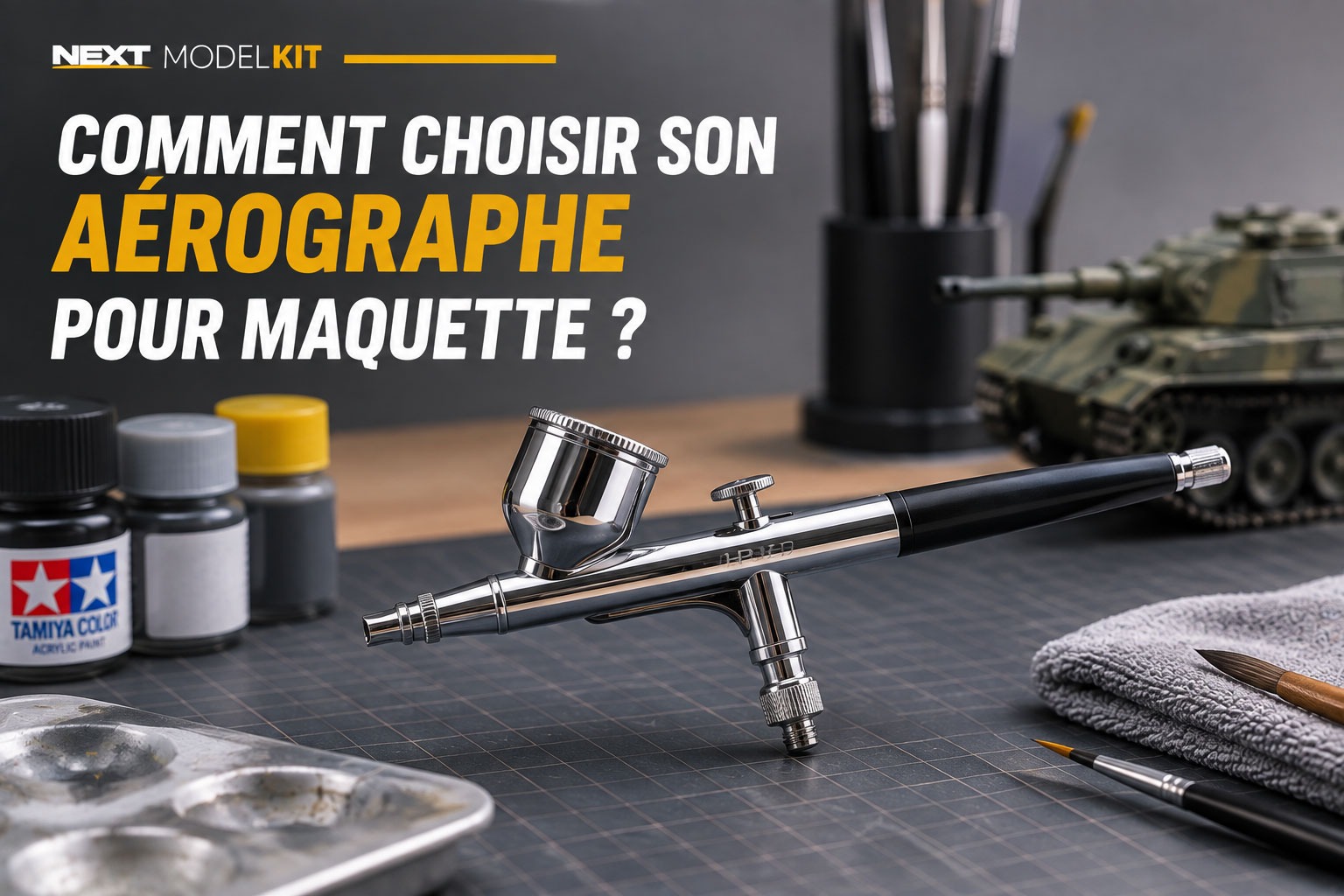
Choosing an airbrush is about matching the tool to the paint, surface size and level of control you need.
Single action or dual action?
Single-action airbrushes are easy to learn and work well for primers and broad coats. Dual-action models control air and paint separately, which makes them more useful for fine lines, gradients and weathering.
Gravity feed or siphon feed?
Gravity-feed cups use small amounts of paint and are well suited to models, figures and touch-ups. Siphon-feed systems can be useful for larger surfaces and multiple jars, but are usually less precise at very low flow.
Choosing a nozzle
- 0.2 mm: fine lines and detail work.
- 0.3 to 0.4 mm: the most versatile range for models.
- 0.5 mm and above: primers, broad coats and thicker products.
Compressor and cleaning
Use a compressor with pressure control and moisture separation. Empty the cup, rinse the paint path and clean the nozzle after each session. Correct thinning and filtering prevent many blockages.
A sensible first setup
A gravity-feed dual-action airbrush with a 0.3 mm nozzle is a strong all-round starting point. Keep a fine brush for details: an airbrush improves regular coats, but does not replace preparation and manual touch-ups.
Related tools and guides
For detail work, add an AK Interactive Essential Brushes set. Before painting, the Vallejo modelling tool set combines cutters, blades and a file, while the Vallejo diamond file set is useful for small parts.
Continue with our guides to scale model painting and washes.
For RC bodywork applications, see our related article on choosing an airbrush for an RC car body.
Comments (0)